
Flight Physics and Control
Paper Plane Glide Journey uses realistic physics to govern every flight. Your plane responds naturally to speed, angle, and air currents, so the same launch can produce different results depending on how you steer. On desktop, you control the plane with either the keyboard or mouse. The challenge lies in making small, precise adjustments rather than sharp movements, because abrupt inputs disrupt stable flight. Each attempt teaches you something about how the plane behaves, and that feedback loop is the core of the experience.
Level Environments and Goals
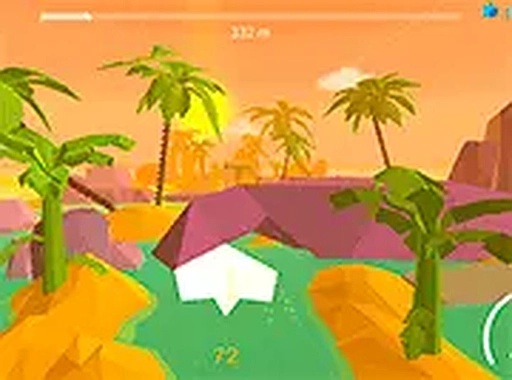
Each level has a destination you must reach by mastering the controls. The 3D environments range from sunny outdoor fields to indoor spaces, and the shift between open and enclosed settings changes how you approach navigation. [IMG_1] Obstacles and air currents appear along the route, and you need to read both to keep the plane aloft. Riding a current can extend your glide or help you gain altitude, while ignoring one may cut your flight short. The goal is always the same: reach the end of the level, but the path there demands different decisions depending on the setting.
Unlockable Plane Designs
The in-game store lets you unlock new paper airplane designs. These add visual variety to your flights and give you something to work toward beyond simply completing levels. [IMG_2] The designs are cosmetic, so they do not alter the physics or difficulty. For players who enjoy personalizing their experience, the store provides a light progression layer that runs alongside the main skill-based challenge.
Who This Game Suits
Paper Plane Glide Journey is built for players of all ages who want a casual, skill-based challenge without complex controls. The learning curve is gentle because every failed flight still teaches you something about speed, angle, or air currents. Patience matters more than fast reflexes here. If you enjoy games where improvement comes from repeated attempts and careful observation, this one fits that mold. Full-screen mode is available for an uninterrupted session.








Editorial Notes