
What You Actually Do Each Level
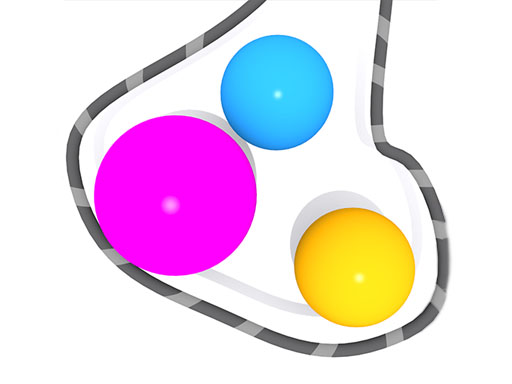
Every stage in Rope Connect presents a fresh arrangement of balls on screen. You use a mouse or touch screen to draw a rope around them. Once you finish drawing, the rope ends pull inward, dragging the balls closer together. The puzzle is solved only when every ball ends up touching at least one other ball after the contraction. That single rule drives all the thinking: where to place the rope, how wide to make it, and which balls need to be pulled toward each other.
Why the Rope Shape Matters
The rope isn't just a lasso. Its shape determines how the contraction pulls the balls. A simple circle might work for a tight cluster, but spread-out balls often need a more complex outline. You might draw a figure-eight, a long oval, or an irregular loop that wraps around specific groups. Because the physics simulation moves the balls based on the rope's path, two different rope shapes can produce completely different results on the same layout. This is where the logic and spatial reasoning come in: you have to predict how the contraction will play out before you release the rope.
No Timers, No Penalties
Rope Connect has no time limits and no penalty for mistakes. You can study the ball positions for as long as you like, try a rope shape, and if it fails, simply redraw. That design choice makes the game approachable for all ages and encourages experimentation rather than speed. The difficulty rises gradually across levels, so early puzzles teach the basic contraction behavior while later ones demand more careful planning. Because there's no pressure, the game works well as a relaxing brain exercise.
Who Will Enjoy This
If you like puzzles that reward observation and logical thinking over reflexes, Rope Connect fits that niche. The controls are simple—just draw—but the solutions require you to think about geometry and physics. It's free to play and suitable for a family-friendly audience. Players who prefer trial-and-error learning will appreciate the freedom to retry as many times as needed.








Editorial Notes