
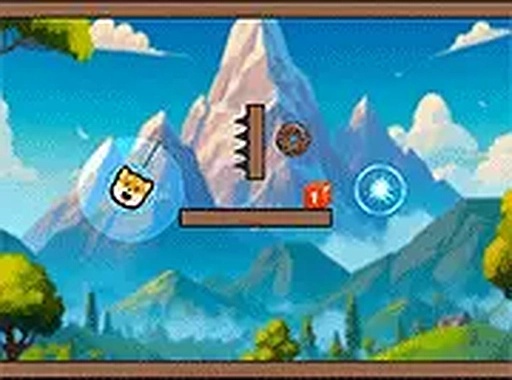
Aim, Pull, Release
Doggie Dash builds its challenge around a single physical action: grabbing the dog, pulling back to set power, adjusting the angle, and letting go. Every throw is a small calculation of force and direction. Because the dog travels in an arc, overshooting or undershooting usually ends the run. The input method works on both mouse and touch, so the same pull-and-release motion applies whether you play on a desktop browser or a phone.
Risk and Reward in Each Layout
Levels are not just empty gaps. Spikes and traps sit between the starting point and the final destination, and each new level rearranges those hazards into a different pattern. Choco donuts are placed around the layout as optional pickups. Going for a donut often means choosing a riskier trajectory or a tighter landing, which creates a genuine trade-off between score and survival. That decision — safe route or bonus route — is the core of the game's skill ceiling.
Difficulty Without Punishment
The difficulty curve comes from layout complexity rather than new controls. Early levels ask for straightforward throws; later ones demand more precise aim and timing as obstacles multiply. There is no combat, no timer pressure mentioned, and no penalty beyond a failed run. That makes Doggie Dash approachable for younger players and for anyone who wants a short session. Bright visuals and a clear objective keep the experience light, while the physics-based aiming gives it enough bite to hold attention beyond a single attempt.






Editorial Notes